
 Written By Sebastian Cain · Updated
If you’ve ever played slots for real money and thought “this slot feels tight” or “this one pays better,” what you’re really reacting to is the relationship between RTP, volatility, and hit frequency. These three concepts explain almost everything about how a slot behaves — and misunderstanding them is the fastest way to burn a bankroll.
This page breaks them down in plain English, with real examples, so you can stop guessing and start choosing slots that actually match how you play. If you want to compare specific games afterward, link back to our Best Slot Games guide or the casinos listed on our Slots For Real Money Homepage.
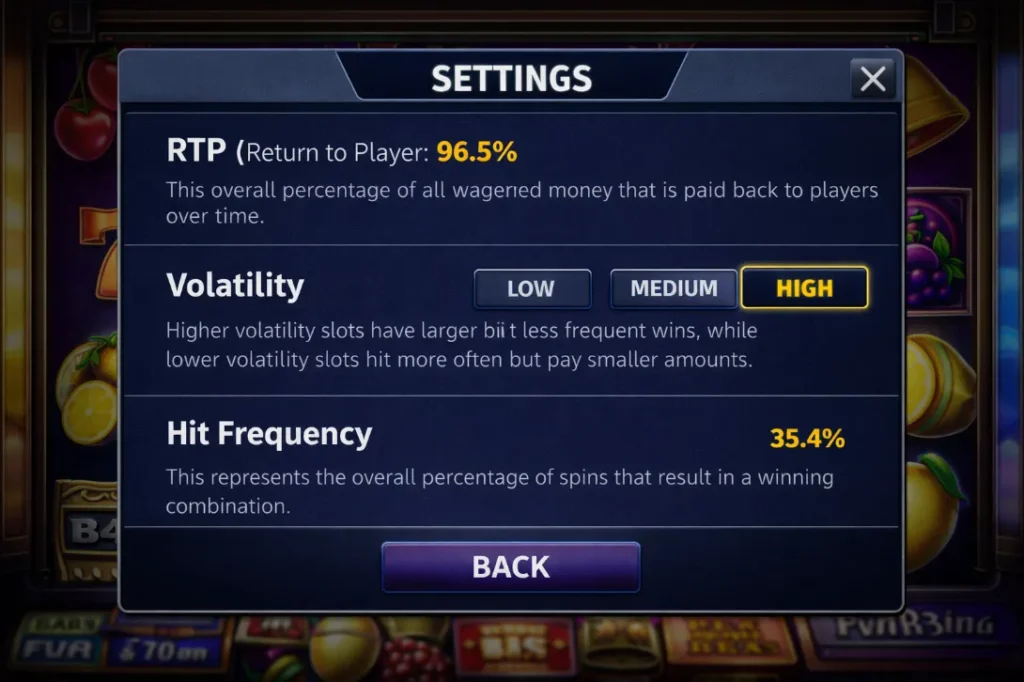
What Is Slot RTP? (And Why Players Misread It)
RTP stands for Return to Player. If a slot has a published RTP of 96%, it means that over an extremely large number of spins, the game is designed to return $96 for every $100 wagered.
The key mistake U.S. players make is assuming RTP applies to a single session or even a single day of play. It doesn’t. RTP is calculated across millions — sometimes billions — of simulated spins. Your personal results can sit far above or far below that number for a long time.
RTP in Plain Terms
- RTP is a long-term statistical average, not a promise.
- It does not reset daily, weekly, or after a bonus.
- A 97% RTP slot can still destroy a small bankroll quickly.
- A 94% RTP slot can still produce a huge short-term win.
This is why two slots with nearly identical RTP percentages can feel completely different to play. RTP tells you how much is paid back over time — not how or when it’s paid.
Hit Frequency vs RTP (Why “Constant Wins” Still Lose)
Hit frequency refers to how often a slot produces any kind of winning spin. This could be a small win that pays less than your bet, breaks even, or produces profit.
A slot with a high hit frequency can feel generous because the reels are lighting up often — but if most wins are tiny, your balance still drains slowly over time. This is why players say things like “I was winning all the time but somehow still lost.”
| Metric | What It Tells You | What It Does NOT Tell You |
|---|---|---|
| RTP | Long-term expected return | Session results |
| Hit Frequency | How often wins appear | Size of wins |
| Volatility | How wins are distributed | Exact timing of bonuses |
Real U.S. Slot Examples (Same RTP, Very Different Outcomes)
To see how RTP, volatility, and hit frequency interact in real-world play, look at popular U.S. offshore slot games from providers like RTG, Betsoft, and Dragon Gaming. Many of these slots sit in a similar RTP range, yet behave completely differently once real money is on the line.
- Diamond Fiesta (RTG): Medium volatility with frequent small-to-mid wins and steady bonus triggers. This slot “feels active” and keeps balances alive longer, especially at lower bet sizes.
- Cash Bandits 3 (RTG): Higher volatility with larger swings and less frequent bonuses. Long quiet stretches are common, but bonus rounds can deliver meaningful spikes.
- Take the Bank (Dragon Gaming): Lower volatility profile with frequent hit patterns and smoother gameplay, often preferred by players stretching smaller bankrolls.
- Play with Cleo (Betsoft): Medium-to-high volatility with stacked features, free spins, and multipliers. Sessions can feel dead for long periods before a single feature defines the result.
Why This Matters
All of these slots operate within published RTP ranges, yet the experience is completely different. Players who don’t understand volatility often assume a slot is “tight” or “cold,” when in reality it’s behaving exactly as designed. Matching the slot type to your bankroll is far more important than chasing the highest RTP number.
You can reinforce this section visually by adding game images for each example slot above. In the next section, we’ll break down volatility levels properly and show how they impact real money play — including why high-volatility slots are the fastest way to burn a small bankroll.
Slot Volatility Explained (This Is What Really Controls Risk)
If RTP tells you how much a slot pays back over the long run, volatility tells you how violently your balance moves along the way. This is the factor that determines whether a slot feels smooth and playable or brutal and unforgiving.
Volatility is essentially the distribution of wins. Low-volatility slots pay more often but in smaller amounts. High-volatility slots pay rarely, but when they do, the wins can be large enough to define an entire session. Most real money slot frustration comes from playing a volatility level that doesn’t match the bankroll.
| Volatility Level | Win Pattern | Session Feel | Bankroll Risk |
|---|---|---|---|
| Low | Frequent small wins | Smooth, steady | Lower |
| Medium | Mixed wins & bonuses | Balanced | Moderate |
| High | Rare but large payouts | Swingy, stressful | High |
Volatility vs Bankroll (Where Most Players Go Wrong)
Volatility only becomes a problem when bankroll size and bet size are ignored. A high-volatility slot isn’t “bad” by default — it’s bad when played with money that can’t survive the dry spells.
| Bankroll | Recommended Volatility | Why |
|---|---|---|
| Under $100 | Low | Preserves spins, reduces wipeouts |
| $100–$300 | Low–Medium | Allows bonuses without extreme swings |
| $300+ | Medium–High (controlled) | Can absorb variance without panic betting |
Classic Player Mistakes
- Jumping into high-volatility slots with minimum deposits.
- Increasing bet size after long losing streaks.
- Assuming a slot is “due” for a bonus.
- Confusing entertainment variance with unfair play.
Are RTP & Volatility Fixed? (Yes — and Here’s Proof)
One of the most persistent myths in online slots is that casinos can secretly adjust RTP or volatility for individual players. In properly licensed environments, this simply isn’t how modern slot software works.
Slot outcomes are generated by certified Random Number Generator (RNG) systems. These systems are tested by independent labs to ensure the math behaves exactly as published.
For a neutral, regulator-level explanation of RNG testing and certification, see: UK Gambling Commission – Random Number Generators . The UKGC doesn’t regulate U.S. offshore casinos, but the underlying slot technology and testing principles are the same.
If you want to put this knowledge into practice, your next step should be learning how to size bets properly and protect your bankroll. Continue with our dedicated guide on bankroll management for real money slot players.